
Making Maple Syrup on Induction Cooktop
Saves Energy & Lowers Carbon Footprint

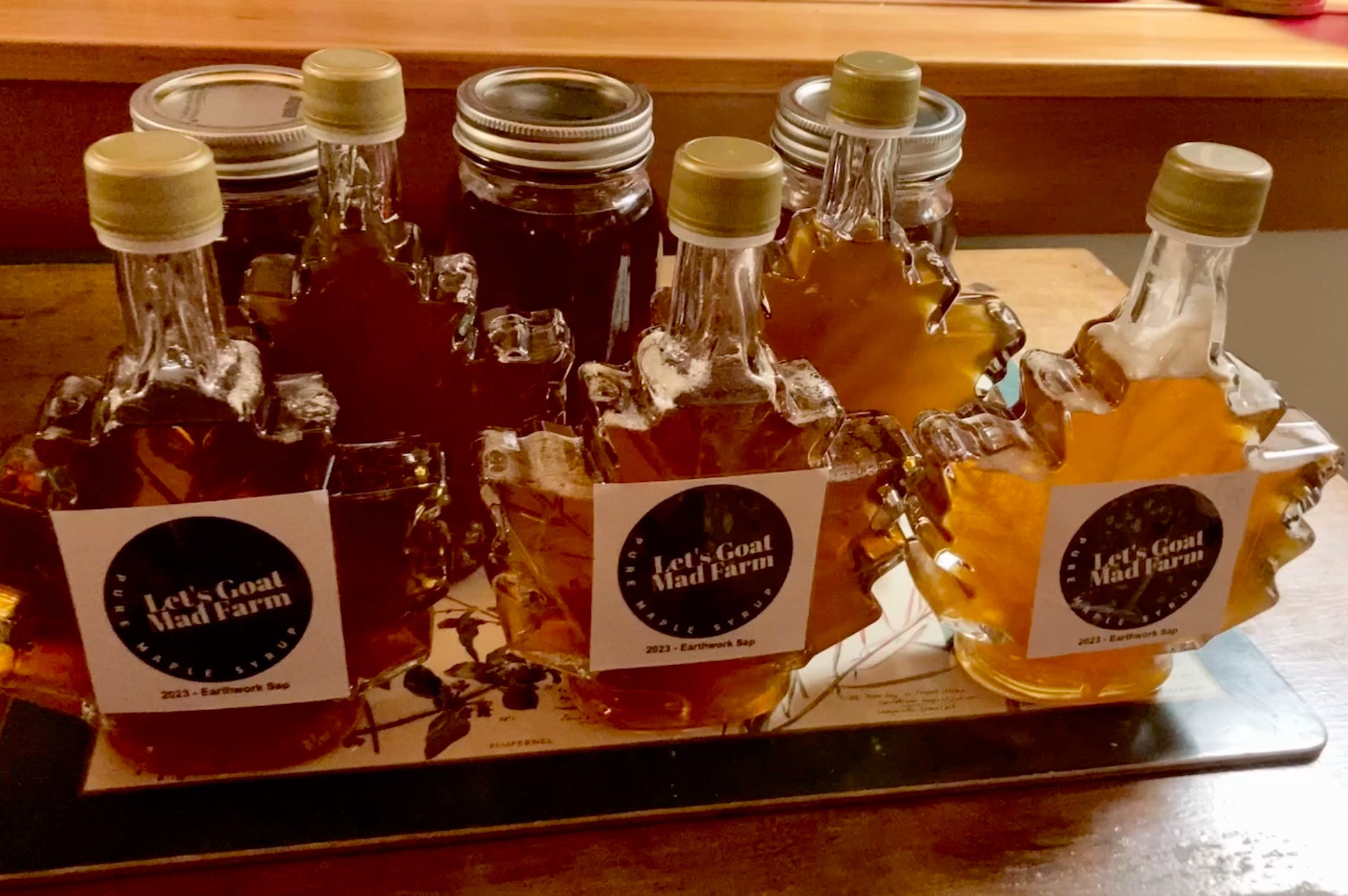
This is my first sugaring season in Vermont. I did a short stint working for a professional maple sugar operation in January/February, tapping some of their 22,000 trees and repairing lines. That was before my bad hip got the best of me hiking in deep snow . . . a story for another day!
So, with my newfound knowledge, I tapped ten maple trees around my house and made about two gallons of syrup from eighty gallons of sap. I learned many lessons this first year, but here is the most important one:
Maple sugaring as a hobby operation is expensive and non-sustainable!
After burning through five tanks of propane on my outside grill and an equal amount inside on my gas cooktop, I wondered if there was a better way. Professional operations use reverse osmosis to speed up syrup production by removing about 80 percent of water from the sap before boiling it in an evaporator pan. But the pre-built RO systems are expensive, and I wasn’t ready to try building my own for less. Instead, I decided to try using a portable electric induction cooktop. I have heard they are more efficient, and so presumably greener and more economical than using gas, wood, or even an electric cooktop. I wanted to find out whether an induction cooktop might work for making maple sugar, which requires about 10-12 hours of continuous boiling to reduce 20 gallons of sap into one-half gallon of maple syrup, a 40-1 ratio. Also, because my kitchen is overdue for renovation after 27 years, I want to consider switching out my gas cooktop to an induction range. Time to weigh the pros and cons.
I did a bunch of research online and ended up buying this cheap 1800-watt double induction cooktop. I got a used “very good” one on sale for about $150. I wanted a double cooktop so that I could fit one of my evaporation pans over two burners to speed up the evaporation process.
Here is my video review of how it went and also a comparison of the economic and environmental costs of using an induction cooktop versus propane to evaporate maple sap into syrup.
Dear Husband (DH) doubted my energy and environmental math, so here it is on paper:
I made a little more than one-half gallon of maple sap out of about 25 gallons of sap on the induction cooktop.
Let’s compare energy costs to make this same amount of syrup with propane versus electricity on an induction cooktop.
Usually, it takes me about 12-14 hours to boil down 25 gallons of sap with 2.5 tanks of propane. At $23 a tank that is about $59 to change this amount of sap into syrup. Or $14.75 in energy for each of the four 500 ml jars of syrup I produced.
Looking online with my utility company – Green Mountain Power – I can determine my daily electricity usage. For the day I used the induction cooktop, I used about twice as much electricity as on a normal day, or about 20KWhs instead of 10.
The cost per KWh here in Vermont is about 20 cents. The average in the nation is closer to 15 cents. Hence my additional 10 KWh cost about $2.00 for the day, or .50 cents to make each of my four 500 ml jars. That is $14.25 less per jar than using propane!
DH sincerely doubted that I used only 10 additional KWhs to evaporate this much sap and suggested I search online to determine the amount of energy required to evaporate 1 gallon of water using induction energy. The closest example I could find was this guy who also tried to figure out the electricity cost of evaporating maple sap with an induction burner using a watt meter and Michigan power rates. He figured it cost him $174 to keep his one-burner induction cooktop operating at high speed 24 hrs a day for 30 days. So that means the cost to operate it for just 12 hours is $2.91, or about $1 more than the $2 I estimated based on my utility usage numbers. Whichever is correct, an induction cooktop is clearly cheaper than propane.
Using electricity to make maple syrup also makes good environmental sense.
An average grill propane tank holds 4.6 gallons of propane when full. If each gallon of propane emits 12.61 lbs of CO2, that’s 58 lbs per tank. Or 145 lbs of CO2 added to the environment for the 2.5 tanks of propane I used to boil down 25 gallons of maple sap.
By comparison, EPA estimates that on average each kWh of electricity produced uses .8 lbs of C02. So I created about 8 lbs of CO2 for the additional 10 kWh of electricity I used with the induction cooktop.
In summary, that’s 145 lbs of CO2 for propane versus 8 lbs with electricity, decreasing my carbon footprint by 137 lbs.
[Important point: my math does not take into account the solar credits I receive from my solar rooftop, which produces between 400-600 KWh each month.]
Here is the bottom line: While there is nothing easy or economical or completely green about making maple syrup, an induction cooktop does make good sense for a hobby maple syrup operation. You can make it more sustainably for far less money.
I did decide to trade in the double induction cooktop I bought for two single induction cooktops to deal with the safety shutoff problem that would only allow one burner to boil sap at a time. Next sugaring season I will use two 1800-watt induction cooktops and also try to find an all-steel evaporator pan that works with an induction cooktop to speed up evaporation time.
I hope this post and video save someone else time and money while reducing your carbon footprint in making delicious maple syrup!